- The program
- The schools
- The accommodations
- The feeding
- Entertainment and sight-seeing
- Volunteers’ safety
- Minimum qualification required
- Rough estimate of total cost involved
- Apply for this program
- Next steps — after you have been accepted
- Other relevant facts about the program
- Sign up for our Newsletter
- Submit a question
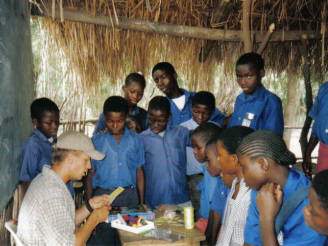 The program
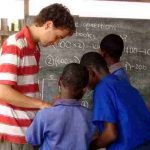
VIGS invites volunteers to teach Science to Ghanaian school children in Primary (Elementary) and Junior High schools based on the Ghana basic education curriculum. The Science curriculum is designed to help the pupil to:
- Develop the spirit of curiosity, creativity and critical thinking
- Develop skills, habits of mind and attitudes necessary for scientific inquiry
- Develop the spirit of curiosity for investigating and understanding their environment
- Communicate scientific ideas effectively
- Use scientific concepts for explaining their own lives and the world around them
- Live a healthy quality life
- Treat all resources of the world with humane and responsible attitude
- Show concern and understanding of the interdependence of all living things and the Earth on which they live
- Design activities for exploring and applying scientific ideas and concepts
You can teach the subject to any one (or more) of eight different classes (or ages).
- Primary class 1 (mean age of 6 years). Read excerpts of the curriculum
- Primary class 2 (mean age of 7 years). Read excerpts of the curriculum
- Primary class 3 (mean age of 8 years). Read excerpts of the curriculum
- Primary class 4 (mean age of 9 years). Read excerpts of the curriculum
- Primary class 5 (mean age of 10 years). Read excerpts of the curriculum
- Primary class 6 (mean age of 11 years). Read excerpts of the curriculum
- Junior High 1 (mean age of 12 years). Read excerpts of the curriculum
- Junior High 2 (mean age of 13 years). Read excerpts of the curriculum
Back to top
PRIMARY 1 SCIENCE – Curriculum excerpts
Living and non-living things, Measurement (length, mass, volume and time), Sun and Earth, Day and night, Simple electronic components, Sunlight, Food, Personal hygiene, Simple machines… (A more detailed curriculum will be provided to you — after you have applied and confirmed your participation in the program) Top
PRIMARY 2 SCIENCE – Curriculum excerpts
Living things (Plants and animals), Water, Air, Rocks, Measurement, Weather conditions, The human body, Parts of a plant, Hot and cold, Sound, Personal hygiene, Simple machines… (A more detailed curriculum will be provided to you — after you have applied and confirmed your participation in the program) Top
PRIMARY 3 SCIENCE – Curriculum excerpts
Soil, Feeding in plants, Feeding in animals, States of matter, Measurement of time, Seasons, Sense organs, Waves, Building simple electronic circuits, Personal hygiene, Water pollution, Water purification… (A more detailed curriculum will be provided to you — after you have applied and confirmed your participation in the program) Top
PRIMARY 4 SCIENCE – Curriculum excerpts
Diversity of matter: Groups of plants, Groups of animals, Metals and non-metals, Rusting, Measurement of temperature. Cycles: Ventilation, Systems: The solar system, Energy: Sources of energy, Interactions: Forces, Inductors and capacitors in an electronic circuit, Care of the skin… (A more detailed curriculum will be provided to you — after you have applied and confirmed your participation in the program) Top
PRIMARY 5 SCIENCE – Curriculum excerpts
Diversity of matter: Parts of flowers and their functions, Measurement. Cycles: Water cycle. Systems: The human body systems. Energy: Forms of energy, Conversion of energy, Change of state of matter, Basic electronics. Interactions of Matter: Magnetism, Mixtures, Water-related diseases, HIV/AIDS… (A more detailed curriculum will be provided to you — after you have applied and confirmed your participation in the program) Top
PRIMARY 6 SCIENCE – Curriculum excerpts
Diversity of matter: Fruits and seeds, Air, States of matter, Measurement of time. Cycles: Life cycles of Okra and Maize plant, Life cycle of the mosquito Systems: The digestive system of humans, Simple electrical circuit Energy: Respiration, Heat, Electrical circuit, Basic electronic circuit. Interactions of Matter: Food processing and preservation, Food poisoning, Natural disaster – flooding… (A more detailed curriculum will be provided to you — after you have applied and confirmed your participation in the program) Top
JUNIOR HIGH 1 SCIENCE – Curriculum excerpts
Matter, Measurement, Nature of soil, Hazards, Life cycle of flowering plants, Vegetable crop production, Fish culture, Respiratory system of humans, Farming systems, Sources and forms of energy, Conservation of energy, Ecosystems… (A more detailed curriculum will be provided to you — after you have applied and confirmed your participation in the program) Top
JUNIOR HIGH 2 SCIENCE – Curriculum excerpts
Elements, compounds and mixtures, Metals and non-metals, Chemical compounds, Water, Carbon cycle, Climate, Reproduction and growth in humans, Heredity, Diffusion and osmosis, Food and nutrition, Electrical energy, Machines… (A more detailed curriculum will be provided to you — after you have applied and confirmed your participation in the program). Top
The schools
VIGS GHANA partner schools are located in many villages, towns and cities in the coastal belt. From Sega in the east through Prampram, Aburi, Tema, Bawjiasi, Accra and all the way to Twifu-Mampong and Takoradi in the west. We also have partner schools in the middle parts of Ghana (Kumasi). Back to top
The accommodations
Most of the accommodation is with carefully-selected host-families, with a couple of dedicated volunteers’ apartments. You would be placed in the same home with another volunteer — except you specifically state that you prefer to be placed alone. Volunteers coming as a pair or couple will not be placed with other volunteers in the same bedroom. Volunteer(s) have their separate room – with a lock and key. There are two beds in the volunteers’ room; each with a mattress and in most cases a table and chair. It is advisable to bring along a mosquito net and a spare bed sheet. Many homes have a shower and flush toilet. In others you would have to manage with a bucket of water and a pit toilet – more likely in smaller towns and villages. Laundry is usually done with a couple of buckets. Back to top
The feeding
You will be served three meals daily. Breakfast is usually tea/ coffee/ oats or corn porridge and bread with jam/ butter/ egg omelet. Lunch could be plantain or rice or yam with vegetable stew or similar. Dinner could be rice, yam, pasta or plantain with vegetable sauce or stew or soup. For dessert you’d be served an orange or pineapple. Back to top
Entertainment and sight-seeing
Weekends are free days. You may choose to travel out of town to see the many interesting sights and sounds in other parts of Ghana or hang out with your fellow volunteer(s) and/or locals in the neighbourhood. VIGS GHANA frequently puts together sight-seeing trips: as a volunteer on one of our programs, you’ll first be given the option to sign-on to our tours. The remaining slots will be offered to the general public. Back to top
Volunteers’ safety
Your safety is of paramount importance to VIGS GHANA. As such we give you all the relevant safety tips, plus we place you only in places where good medical services are within easy reach. In addition, we’ll give you a smart phone – so you can call or text or email or Whatsapp the in-country supervisors whenever the need arises. Our in-country support staff are on call 24 hours a day, 7 days a week. Back to top
Minimum qualification required of volunteers for the program: Applicants for this program must have at least completed high school. Back to top
Rough estimate of total cost involved
- Flight to and from Ghana: US$600-1250 (Round-trip)
- Ghana visa: US$80-170
- Vaccinations: US$150-250
- Travel Insurance: US$70-320
- Miscellaneous personal items: US$300-900
- Personal Spending money whilst in Ghana: US$200 upwards
- VIGS GHANA Program fee: starts from US$450
So, a rough estimate of the total cost for a two-week program duration would be about US$1,870 – 3,560. Check the equivalent in your currency. Back to top
Next steps — after you have been accepted and given your Placement information
After you have been admitted to participate in the program, you would now have to execute the following:
- Book a flight. See our flight information page. The earlier you book and confirm your flight, the better.
- Go through the suggested checklist of things to do and bring and start getting (or packing) them.
- Send us your flight itinerary
- 60-30 days before your departure date, you must start processing for your Ghanaian visa. VIGS GHANA will provide you with the needed references in Ghana — which are needed to obtain a Ghanaian visa. Back to top
Other relevant facts about the program
- Minimum volunteering/internship duration: 1 week.
- Maximum duration: 6 months.
- Age range accepted: 18 – 75 years.
- We will send you a document on how to fund-raise for your trip – after you’ve confirmed your participation.
- We will meet you at the Airport in Accra (ACC) on your arrival day.
- The average work day is 3-8 hours for this program.
- Saturdays and Sundays are free days.
- You can contact VIGS GHANA local staff on cell phones all the time — 24 hours a day — seven days a week.
- We can give you a Testimonial on successful completion of your volunteer or internship work.
- You can pay the program fee through any of the following methods:
- PayPal or debit/credit card.
- Cash installments (or full payment) upon arrival into Ghana.